
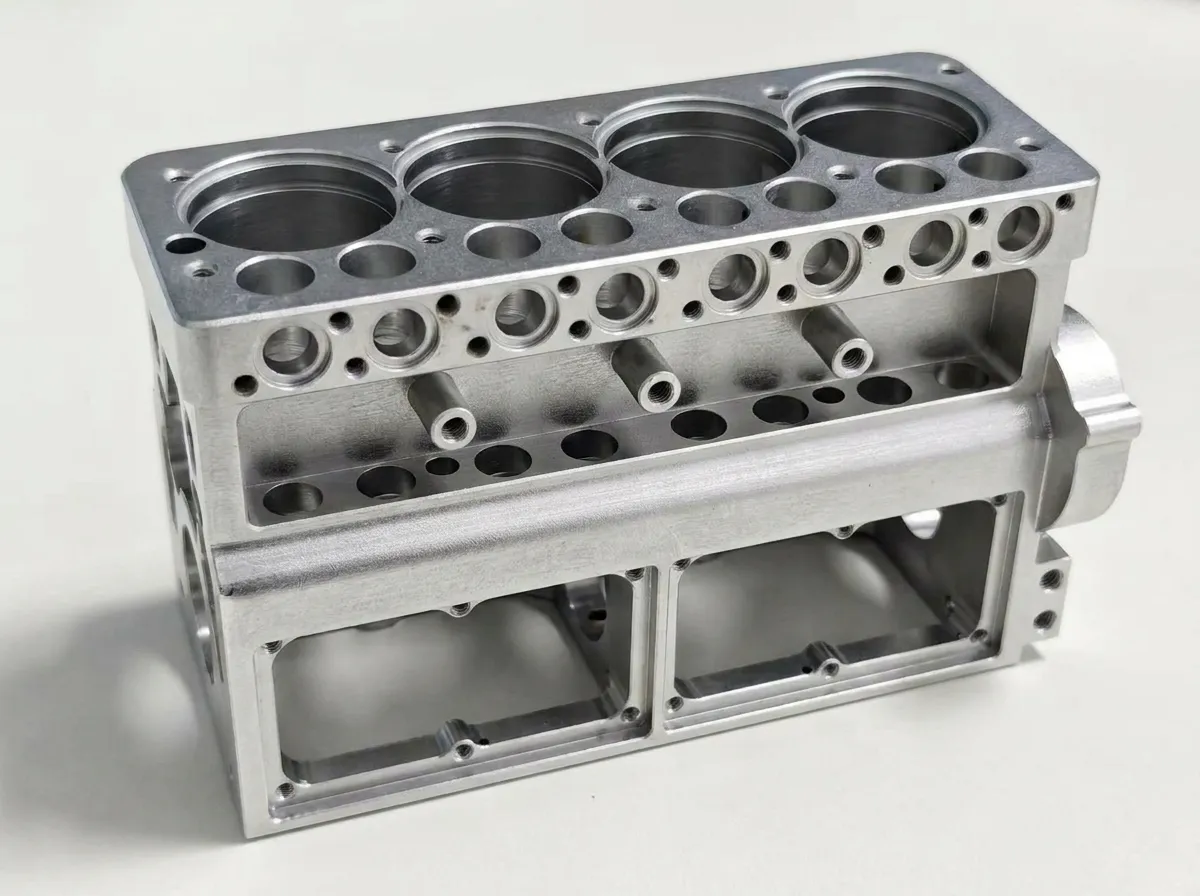
A finished cylinder block looks deceptively simple sitting on a workbench: four round bores, a flat deck, a grid of threaded holes. What that block actually represents is dozens of individual machining operations, each holding tolerances measured in microns rather than millimeters. Let one bore drift slightly out of round, or let the deck surface warp by a few thousandths, and the engine built around that block will fight you at every step — blown head gaskets, uneven compression, premature bearing wear. For OEMs, racing teams, and aftermarket engine builders sourcing blocks from overseas CNC suppliers, understanding what actually happens on the shop floor is often the single biggest factor separating a smooth production run from a costly redo.
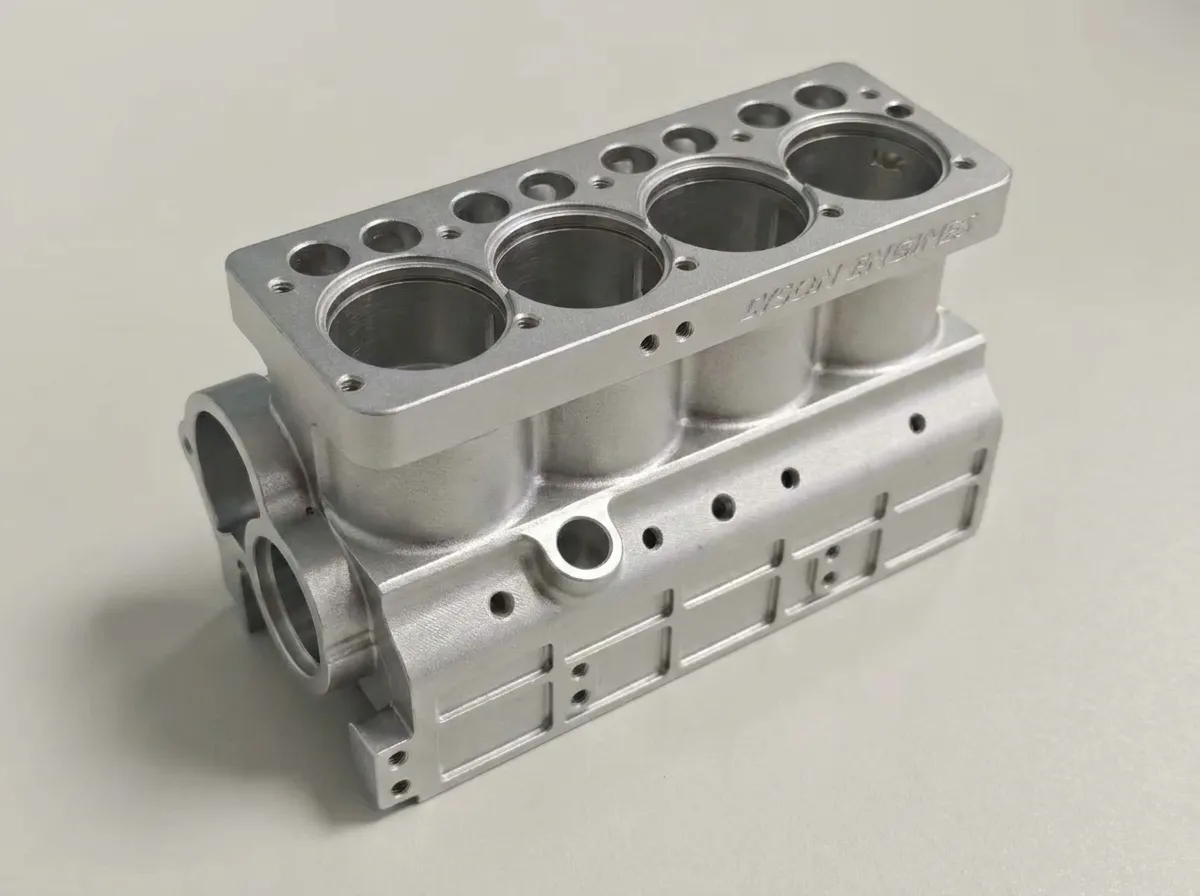
This guide walks through why aluminum has become the default material for modern block design, which machining steps genuinely determine engine performance, and what separates a dependable CNC manufacturing partner from a risky one.
Why Aluminum Dominates Modern Block Design
Cast iron ruled engine block production for most of the twentieth century, and it still shows up in heavy-duty diesel platforms and a handful of high-output racing blocks. But for the large majority of automotive, motorsport, marine, and small-engine platforms built today, aluminum alloys — commonly 6061 wrought stock or A356-type casting alloys — have taken over. The appeal isn't only weight, though a reduction of roughly 40–45% versus iron is significant on its own. Aluminum's thermal conductivity is several times that of cast iron, which pulls heat away from the combustion chamber more quickly, stabilizes operating temperature, and reduces the risk of detonation under sustained load. It also cuts more easily than iron, so tighter tolerances become achievable in less spindle time — a factor that feeds directly into lead time and unit cost on any production run.
| Property | Aluminum Alloy (6061 / A356) | Cast Iron |
| Density | ≈ 2.70 g/cm³ | ≈ 7.20 g/cm³ |
| Thermal conductivity | ≈ 150–170 W/m·K | ≈ 50–55 W/m·K |
| Machinability | Excellent; faster cycle times | Good, but higher tool wear |
| Corrosion resistance | Strong; improved further by anodizing | Requires coating or painting |
| Typical applications | Passenger vehicles, motorsport, marine, small engines | Heavy-duty diesel, select high-output racing blocks |
Material property references for 6061 aluminum are drawn from published alloy data; for a deeper technical breakdown see this 6061 aluminum alloy reference.
Why CNC Specifically, and Not Manual Machining
• Repeatability across production runs — critical when a single block carries 20+ precision features that must all reference the same datum
• Cylinder bore tolerances as tight as ±0.01mm, a level manual boring struggles to hold consistently across a batch
• Multi-axis machining centers complete a block in fewer setups, which reduces the stack-up error that comes from repositioning a casting between operations
• Digital toolpaths make it straightforward to run a small prototype batch and then scale to full production from the same CAD file, without retooling from scratch
Inside the Machine Shop: The Operations That Actually Determine Engine Performance
Not every machining step on a cylinder block carries equal weight. A handful of operations directly determine whether the finished engine runs true, seals properly, and survives its service life.
| Operation | Purpose | Typical Tolerance | Notes |
| Cylinder boring | Sets bore diameter and roundness for piston fit | ±0.01–0.02mm | Usually followed by honing |
| Deck surface milling | Creates a flat sealing face for the head gasket | Flatness within 0.02–0.05mm | An uneven deck is a leading cause of head gasket failure |
| Line boring (main bearing bore) | Aligns crankshaft bearing bores on a common axis | ±0.01mm, coaxiality critical | Often performed with a torque plate fitted to simulate clamped-head load |
| Drilling & tapping | Head bolt holes, oil galleries, dowel pin holes | Position tolerance ±0.05mm | High hole count means cumulative error risk |
| Honing | Produces the crosshatch finish inside the cylinder bore | Surface roughness Ra 0.2–0.4 μm | Retains the oil film that seats piston rings |
Heat, Distortion, and Why Torque-Plate Honing Matters
Aluminum expands more under cutting heat than iron does, so a shop that skips coolant control or torque-plate fixturing can ship a block that measures perfectly round on the inspection bench and still distorts once the cylinder head bolts are torqued down in the field. A quality-focused supplier bores and hones the cylinder under simulated clamping load, so the bore stays round in the assembled engine rather than only under the CMM probe.
The crosshatch pattern produced during honing is what allows the piston rings to retain a lubricating oil film — a factor that directly affects friction losses and blow-by, as documented in published SAE technical research on cylinder bore honing, which is worth reviewing if your team is setting internal surface-finish specifications.
Quality Control Checkpoints Worth Asking About
• CMM (coordinate measuring machine) inspection of bore diameter, roundness, and position tolerance on every batch — not only first-article samples
• Deck flatness verification using precision straightedges or optical flats
• Pressure and leak testing of oil galleries and water jackets before the block ships
• Material certification and lot traceability, so any block can be traced back to its aluminum billet or casting heat
• A documented quality management system — ISO 9001 certification is the baseline most serious buyers should expect from any CNC supplier before placing a production order
Choosing a CNC Manufacturing Partner: What Actually Matters
Once the technical requirements are clear, the harder question is which supplier can actually deliver them at volume, on schedule, and without a string of change orders. A short evaluation checklist tends to save far more time than it costs:
| What to Look For | Why It Matters |
| Multi-tasking machining centers (mill-turn, 5-axis) | Fewer repositioning steps mean tighter geometric tolerance stack-up |
| In-house casting or forging capability | Shortens lead time and gives one point of accountability from raw material to finished block |
| In-house surface treatment (anodizing, plating) | Improves corrosion resistance without adding another vendor and shipping leg |
| Documented case history in engine or automotive parts | Shows the shop has already solved the fixturing and tolerance issues specific to blocks |
| ISO 9001 or equivalent certification | Baseline evidence of documented process control and traceability |
| Flexible MOQ, from prototype to mass production | Lets you validate a design before committing to volume tooling |
At MK Machinery, engine block work runs through the same CNC machining division that handles our broader precision parts portfolio. Our shop floor includes Mazak INTEGREX multi-tasking centers alongside 35 CNC lathes and 16 CNC milling machines — equipment detailed on our equipment page — which lets us move a block from rough casting to a finished, honed bore without shuttling the part between multiple external vendors. For clients who need the raw casting produced first, our precision casting service handles the aluminum die-casting stage in-house, and parts that need corrosion protection can go straight into our surface treatment line for anodizing before final inspection.
From Prototype to Volume: A Real Production Example
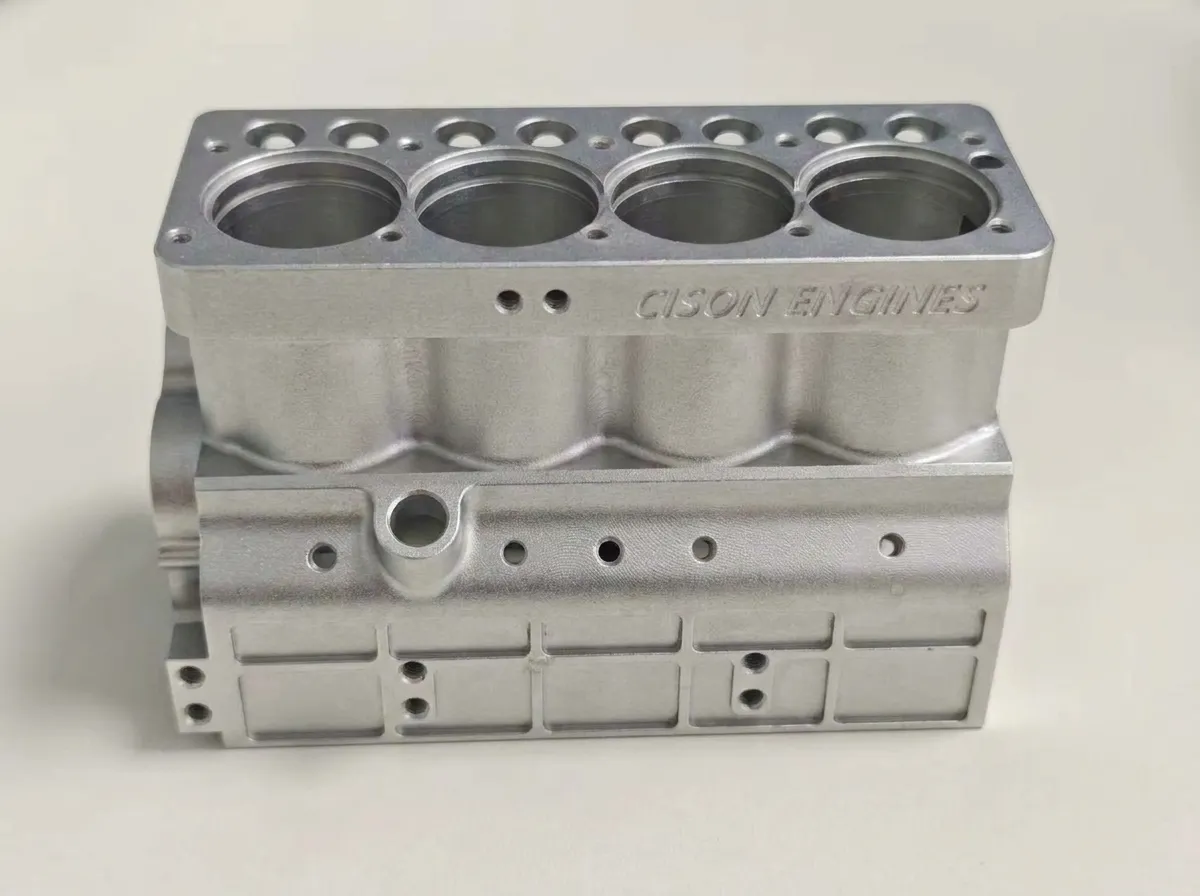
One useful benchmark is our own automotive engine block case: a leading automotive manufacturer needed mass production of high-precision engine blocks with complex internal structures and strict tolerance requirements across every unit. The approach combined horizontal machining centers with specialized fixtures and a standardized process built specifically around that block's geometry. Output has held at roughly 500 units a month with a 99.8% qualification rate — the kind of consistency that comes from a process engineered for repeatability, not just a single good sample part. A similar level of discipline carries over into our aerospace component work, where engine and landing gear parts are held to even tighter tolerance bands for international aviation clients.
Ready to Machine Your Next Engine Block?
Whether you're prototyping a single billet block for a race program or sourcing a full production run of aluminum cylinder blocks for an automotive platform, MK Machinery's CNC machining division is built for both ends of that spectrum. Our process covers precision casting, multi-axis machining, line boring, honing, and anodized surface finishing — all under one roof in Dongguan, China. With 5-axis and mill-turn equipment, a documented track record in automotive and aerospace engine components, and monthly capacities proven at hundreds of units with a 99.8% qualification rate, we can take your block from CAD file to a torque-plate-honed, ready-to-assemble part. Contact our engineering team for a project review and a quote tailored to your tolerances, volume, and timeline.