
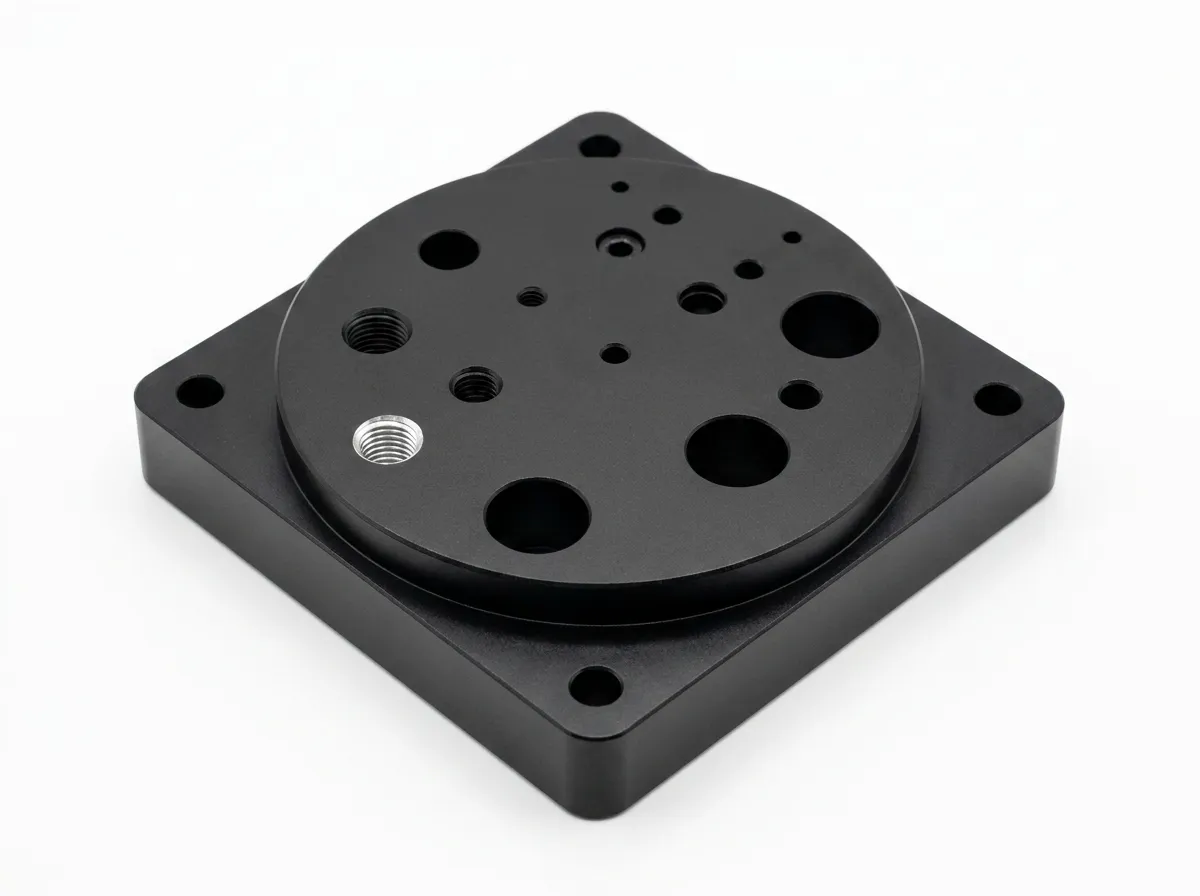
In modern industrial manufacturing, aluminum parts are expected to deliver more than accurate dimensions. Engineers increasingly require components that combine mechanical performance, long service life, clear identification, and premium appearance. The aluminum component shown in this project represents a typical high-value CNC machined part: a precision aluminum block featuring threaded ports, functional openings, surface labels, and a durable black finish.
For this type of component, two secondary processes play an important role after CNC machining: hard anodizing and laser engraving. Together, these processes transform a machined aluminum part into a production-ready component suitable for demanding industrial environments.
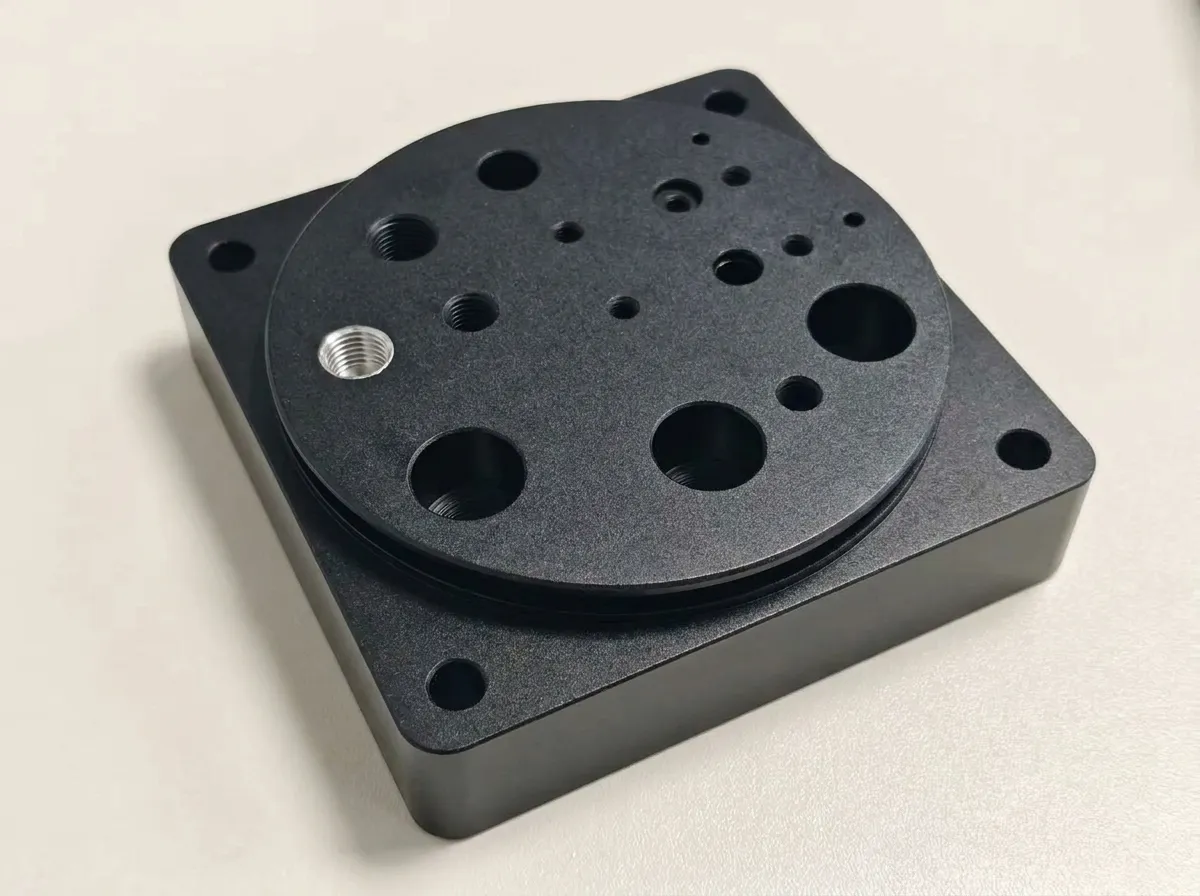
Hard anodizing is a Type III anodic coating process designed to create a thicker and harder aluminum oxide layer. According to industry references, Type III hard anodizing under MIL-A-8625 is commonly used where wear resistance, corrosion protection, and surface durability are required.
Reference: https://members.anodizing.org/page/military-spec-anodic-coatings
Product Overview: Precision CNC Aluminum Block with Functional Features
The component in this project is manufactured from aluminum alloy and produced through CNC machining.
The design includes:
• Multiple precision threaded holes for connection and assembly purposes.
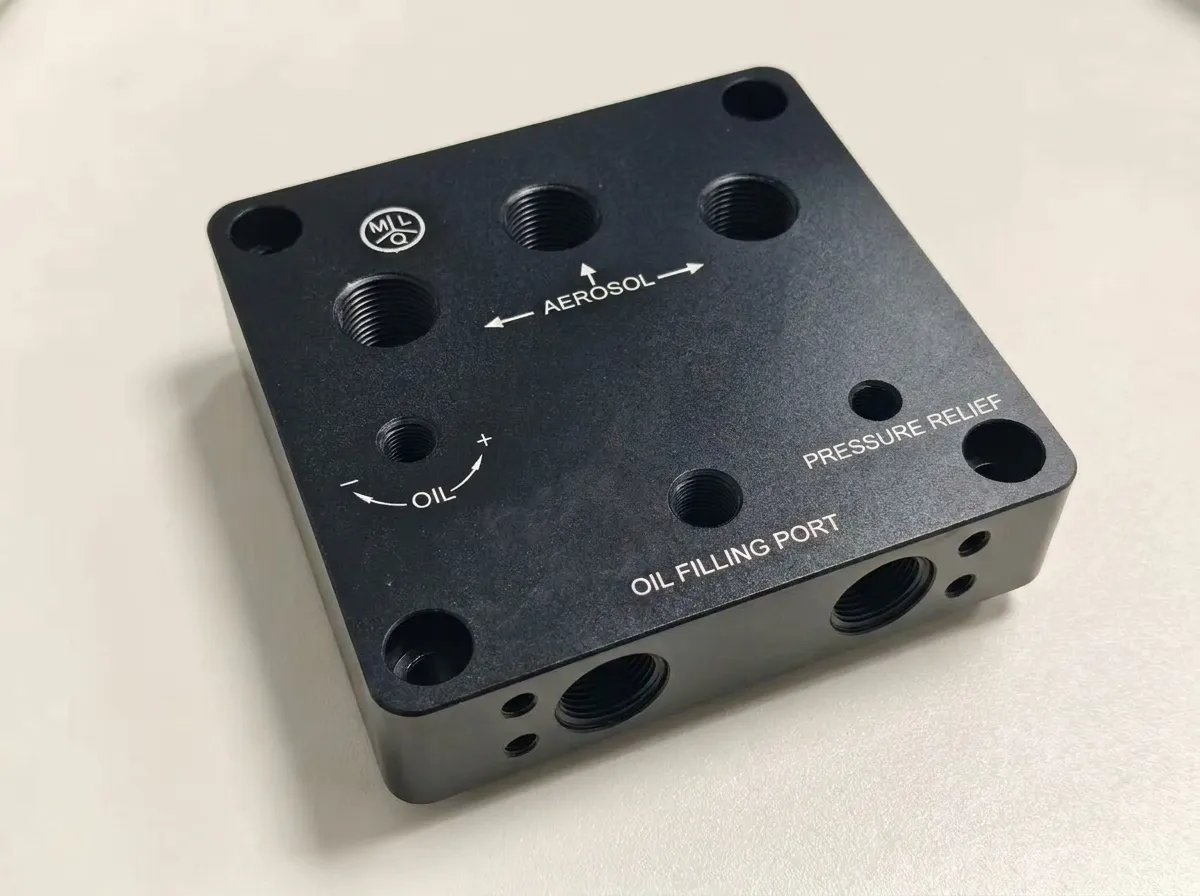
• Dedicated oil filling and pressure relief ports.
• Aerosol-related flow connection interfaces.
• Laser engraved identification marks and operating instructions.
• Black hard anodized surface finish for improved durability.
Such parts are commonly found in industrial equipment, fluid control systems, testing equipment, automation systems, and customized mechanical assemblies.
Unlike simple decorative aluminum products, these components require strict control of machining accuracy because every hole position, thread specification, and sealing surface can influence final assembly performance.
Why CNC Machining Is Ideal for Aluminum Industrial Parts
Aluminum is one of the most widely used materials in precision manufacturing because it provides an excellent balance between strength, weight, corrosion resistance, and machinability. CNC machining allows manufacturers to achieve:
1. High dimensional accuracy
Complex hole patterns, internal features, and mounting structures can be produced with repeatable precision.
2. Excellent surface quality
Proper cutting parameters and tooling selection create a smooth surface that improves both appearance and the final anodizing result.
3. Design flexibility
From prototypes to low-volume production runs, CNC machining supports customized engineering requirements.
For aluminum components requiring post-processing, machining quality is especially important because surface defects, scratches, or inconsistent finishes may remain visible after anodizing.
The Role of Hard Anodizing in Aluminum Part Performance
Hard anodizing is more than a cosmetic coating. It creates a controlled oxide layer that becomes part of the
aluminum surface. The major advantages include:
1. Improved Wear Resistance
Industrial components often experience friction, repeated assembly, and mechanical contact. Hard anodizing creates a harder surface that helps reduce wear during operation.
2. Better Corrosion Protection
Although aluminum naturally forms an oxide layer, hard anodizing significantly enhances surface protection and improves resistance in challenging environments.
3. Professional Industrial Appearance
The dark gray to black appearance commonly associated with hard anodized aluminum gives components a clean, high-end engineering finish. NASA technical guidance on anodizing also highlights the importance of controlling coating thickness and considering dimensional effects when designing anodized aluminum components.
Why Laser Engraving Is Valuable for Industrial Components
Laser engraving provides permanent marking without adding labels, stickers, or printed graphics.
For this aluminum part, laser engraving is used to clearly identify:
• Port functions.
• Direction indicators.
• Oil adjustment information.
• Assembly instructions.
• Product identification details.
Compared with traditional printing methods, laser marking offers excellent durability because the information is physically created on the metal surface.
This is especially valuable for industrial equipment where markings must remain readable throughout the product
life cycle.
Manufacturing Challenges and Quality Considerations
Producing a CNC aluminum part with both functional machining features and cosmetic finishing requires careful
process planning. Important considerations include:
- Material Selection
Common aluminum alloys such as 6061 and 7075 are frequently selected for CNC applications because they provide good machinability and mechanical performance.
- Machining Before Anodizing
The machining process must consider anodizing requirements. Threaded holes, precision bores, and sealing areas
may require specific tolerances because anodizing adds coating thickness.
- Surface Preparation
Before hard anodizing, manufacturers must control:
• Surface roughness.
• Tool marks.
• Burr removal.
• Cleaning quality.
A consistent machining finish leads to a more uniform anodized appearance.
- Masking and Inspection
Some functional areas may require masking during anodizing to maintain final dimensions. Professional CNC suppliers inspect critical features after finishing to ensure assembly compatibility.
How MK MACHINERY Supports Customized Aluminum Manufacturing
As a CNC machining supplier, MK MACHINERY focuses on providing integrated manufacturing solutions from precision
machining to surface finishing. For customers developing aluminum industrial components, a reliable manufacturing partner can simplify the
entire process:
• CNC milling and turning.
• Aluminum prototype machining.
• Low-volume production.
• Surface finishing solutions.
• Quality inspection.
• Customized engineering support.
More information about CNC machining solutions can be found on the MK MACHINERY website: Combining machining expertise with finishing knowledge helps customers reduce supplier coordination time and achieve consistent production quality.
Conclusion
The combination of CNC machining, hard anodizing, and laser engraving creates aluminum components that are both functional and visually professional. The featured aluminum block demonstrates how precision manufacturing and advanced surface treatment can improve durability, usability, and product value.
For engineers selecting a CNC manufacturing partner, the ability to manage machining and finishing together is a major advantage. A supplier with experience in aluminum machining and surface treatment can help transform engineering designs into reliable industrial products.
Partner with MK MACHINERY for Precision Aluminum CNC Solutions
Looking for a dependable CNC machining partner for custom aluminum components? MK MACHINERY provides precision CNC machining, aluminum fabrication, and professional finishing solutions for prototypes and production parts. From complex threaded blocks to customized industrial housings, our team helps customers achieve accurate, durable, and production-ready components. Contact MK MACHINERY today to discuss your next CNC machining project and discover how our manufacturing capabilities can support your product development.