
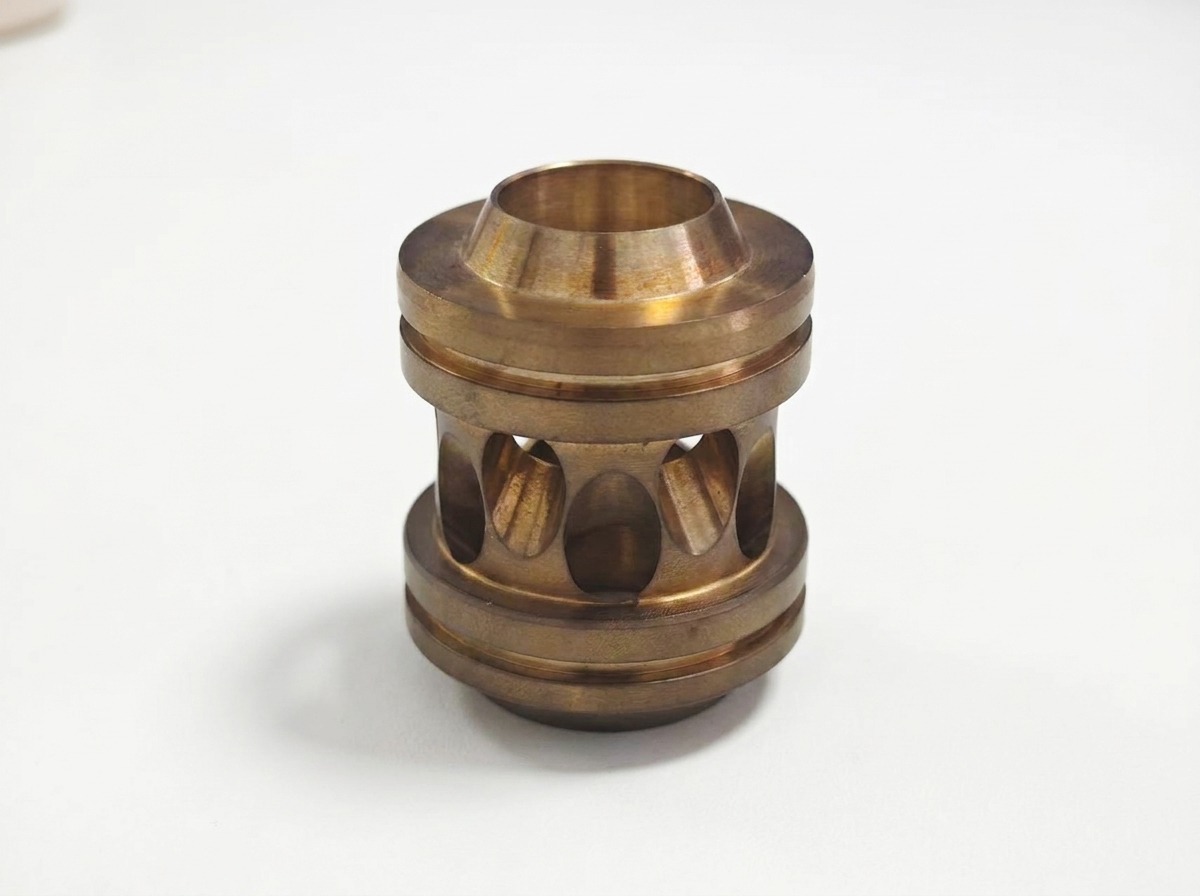
Not every critical component in a piece of rotating machinery gets top billing. Bearing cages are a good example — nobody designs a gearbox around them, yet get the geometry wrong and the whole assembly runs hot, loud, and short-lived. The brass retainer featured in this case study illustrates why cage machining deserves more attention than it usually gets: a two-flange, six-pocket cage with an internally splined bore, held to tolerances that leave almost no room for tool deflection or setup error.
This post walks through what the part is, why brass was the right call for it, and how our shop approached the turning and multi-axis milling operations needed to produce it in volume.
What a Machined Brass Cage Actually Does
A bearing cage — also called a retainer or separator — sits between the rolling elements (balls or rollers) inside a bearing assembly. It doesn't carry the working load directly, but its job is arguably just as important:
• Spacing — keeps rolling elements evenly distributed so they don't clump, rub, or skew inside the raceway
• Guidance — steers each element along a consistent path through the load zone, especially during starts, stops, and reversals
• Lubricant distribution — the pocket geometry helps carry grease or oil evenly across contact surfaces
• Noise and vibration control — a cage machined true to the bore and OD minimizes metal-to-metal contact outside the intended rolling path
Stamped steel cages cover the low end of the market. For higher loads, higher speeds, or corrosive and high-shock environments, machined bronze or brass cages take over, because they're cut from solid bar stock rather than formed sheet — which means tighter pocket tolerances, better dimensional stability under load, and a stiffer structure overall.
Anatomy of This Part
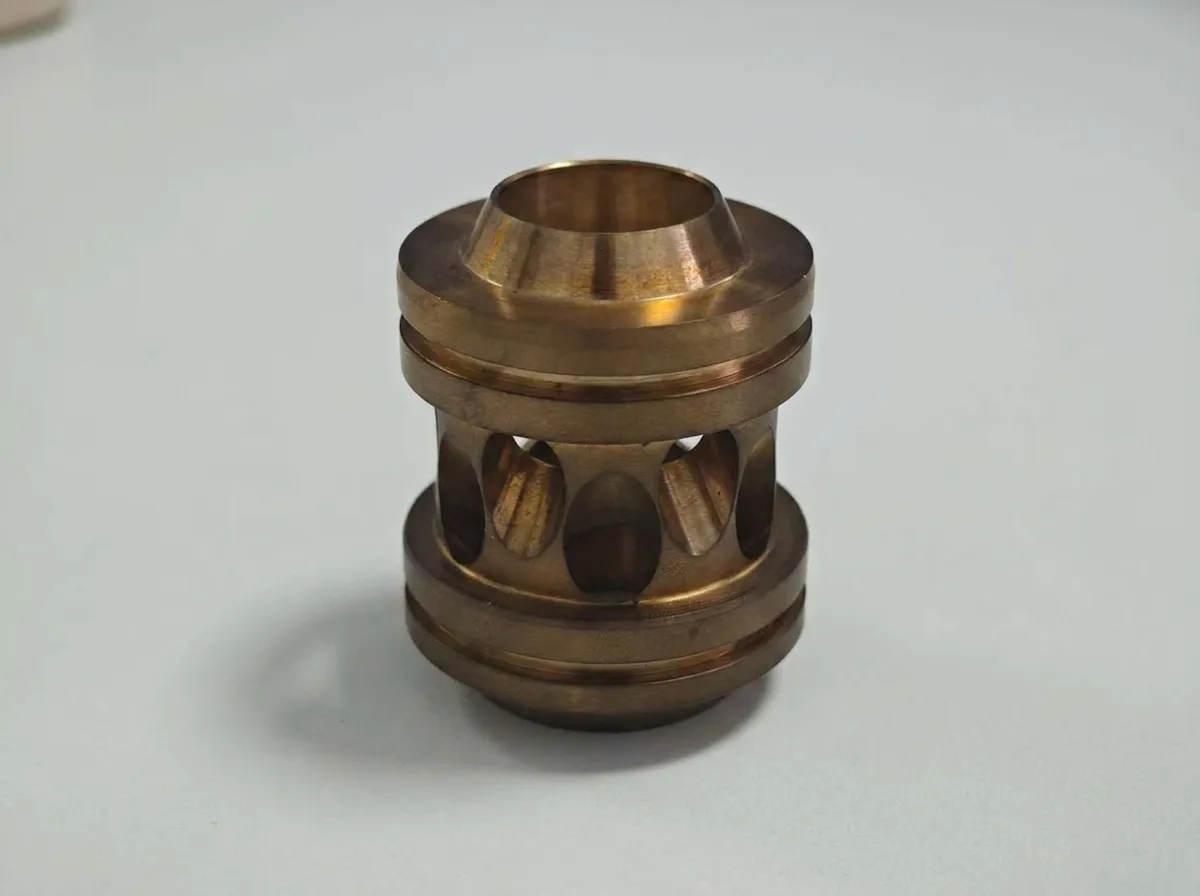
The component in these photos is a good reference for what a machined cage typically looks like once it leaves the mill:
• A stepped bore at the top with internal splines/grooves, sized to register against a mating shaft or hub
• A raised flange collar separating the bore section from the cage body
• Six symmetrically indexed oval pockets machined around the circumference — the windows that will house the rolling elements
• A second flange at the base, mirroring the top for balanced stiffness and consistent wall thickness between pockets
The thin webbing left between each pocket is where most of the risk lives. Too much material removed and the cage loses rigidity under centrifugal load at speed; too little and the pockets don't clear the rolling elements properly. Every one of those six windows has to land on the same index angle, the same depth, and the same profile as its neighbors — this is not a part that tolerates operator-to-operator variation.
Why Brass for This Application
Brass has been the go-to alloy for machined cages for decades, and the reasoning holds up under closer inspection. High-strength leaded brasses combine self-lubricating behavior, good fatigue resistance, and — critically for a shop cutting six precision pockets per part — excellent machinability.
Free-cutting brass alloys such as UNS C36000 are the industry benchmark here: the Copper Development Association rates this alloy's machinability at 100 on the scale used for all copper alloys, making it the most widely consumed commercial copper alloy in the industry and the reference point every other alloy is measured against. For cage work specifically, that machinability translates directly into:
• Clean pocket walls without the tearing or built-up edge that shows up in gummier alloys
• Predictable tool life across a long production run of identical pockets
• Natural corrosion and wear resistance, which matters once the cage is sitting in grease or oil for years
• A degree of self-lubrication at the pocket-to-element contact surface, reducing dry friction during startup
For heavier-duty or higher-strength retainer applications, shops will step up to higher-strength leaded brasses or aluminum bronzes rather than the free-cutting grade — but the underlying logic is the same: a copper alloy that machines predictably and holds a stable pocket geometry over the life of the bearing.
How We Machined It
Producing a cage like this cleanly comes down to sequencing the turning and milling operations so that every reference surface stays consistent from the raw bar to the finished part.
Turning. The blank starts on the lathe, where the OD steps, the two flange diameters, and the internal bore are roughed and finished in as few setups as possible. Every re-chucking operation is a chance to lose concentricity between the bore and OD, so we hold the part on a single reference wherever the geometry allows, similar to the fixturing approach we use on long, slender shaft work — see our precision shaft component case study for a related example of controlling roundness and straightness through the turning sequence.
Internal features. The splined/grooved bore section is cut once the outer geometry is established, so the internal profile references off a surface that won't move again.
Pocket milling. This is where the part earns its “cage” name. Using indexed multi-axis milling, each of the six oval windows is cut on a repeating angular pattern around the cylinder. Consistent indexing accuracy is what keeps every pocket identical — any drift here shows up immediately as uneven wall thickness once the part is sectioned or inspected.
Deburring and inspection. Brass's short-chip behavior keeps burrs manageable, but the pocket edges still get a full deburr pass before the part goes through dimensional inspection — bore diameter, pocket width and depth, flange thickness, and overall concentricity are all checked against print.
Where This Kind of Cage Gets Used
Machined brass retainers show up wherever a bearing needs to handle speed, load, or contamination beyond what a stamped steel cage can tolerate. Industry references consistently point to the same use cases: heavy-duty equipment such as crushers and vibrating screens, where the shock loads and contamination call for the toughness and wear resistance of a machined bronze or brass cage. The GlobalSpec engineering reference on bearing retainers adds that brass is also favored in harsh or corrosive environments for its favorable noise characteristics. Typical applications include:
• Industrial gearboxes and speed reducers
• Marine propulsion and deck machinery bearings
• Wind turbine main shaft and gearbox bearings
• Heavy mobile equipment and off-highway drivetrains
• Mounted bearing units in food, beverage, and processing environments
As Machine Design's overview of bearing retainers puts it, stamped bronze or brass retainers for ball bearings are generally treated as an extra-cost option reserved for high-speed applications, where the added stiffness and wear resistance justify the premium over plain stamped steel. That's the same logic that applies to a lot of the brass and bronze component work we run through our shop — it's rarely the cheapest option, but it's chosen when downtime is the more expensive outcome. Our precision casting and machining work for industrial valve manufacturers follows a similar pattern, where copper-alloy and stainless components are selected specifically for their performance under continuous, demanding service.
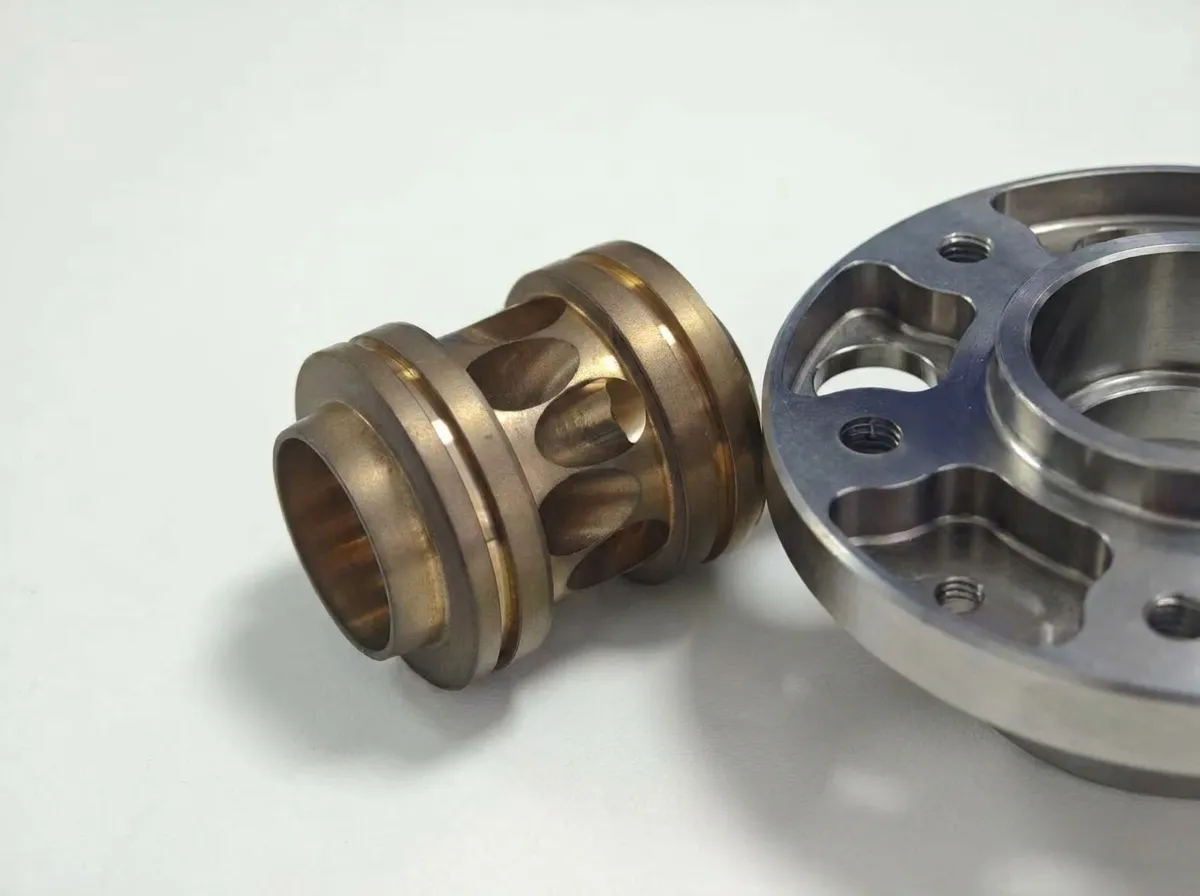
Precision Cage Machining, Built Around Your Print
If you're sourcing machined brass or bronze bearing cages, valve components, or any rotationally symmetric part with tight indexed features, MK Machinery runs the CNC turning and multi-axis milling capability to hold pocket-to-pocket consistency across full production runs — not just a single sample part. Our team works from your print or reverse-engineers from a sample, confirms material and tolerance callouts up front, and verifies concentricity and pocket geometry on every batch before it ships. Whether you need a one-off prototype or a repeatable production run, get in touch with our engineering team for a quote.