
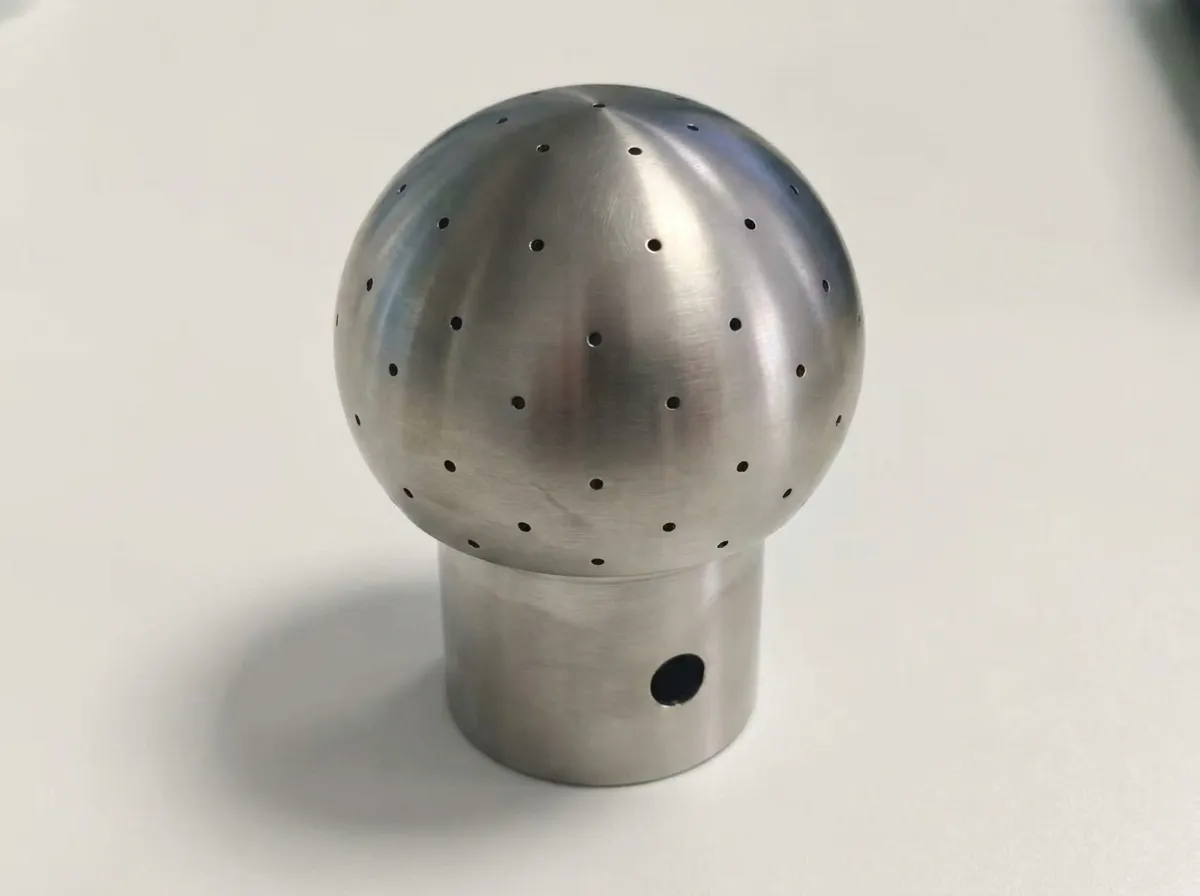
A titanium sphere the size of a golf ball, covered in more than sixty holes the width of a pencil lead, isn't the kind of part that survives a stamping press or a casting mold. It has to be machined — and machined with a level of positional accuracy that most shops never encounter. This case study breaks down what that part actually is, why manufacturers keep specifying titanium for it, and how a CNC machining supplier turns a solid bar of Ti-6Al-4V into a finished spray-ball shower filter without a single misplaced hole.
What Exactly Is a Titanium Shower Filter Ball?
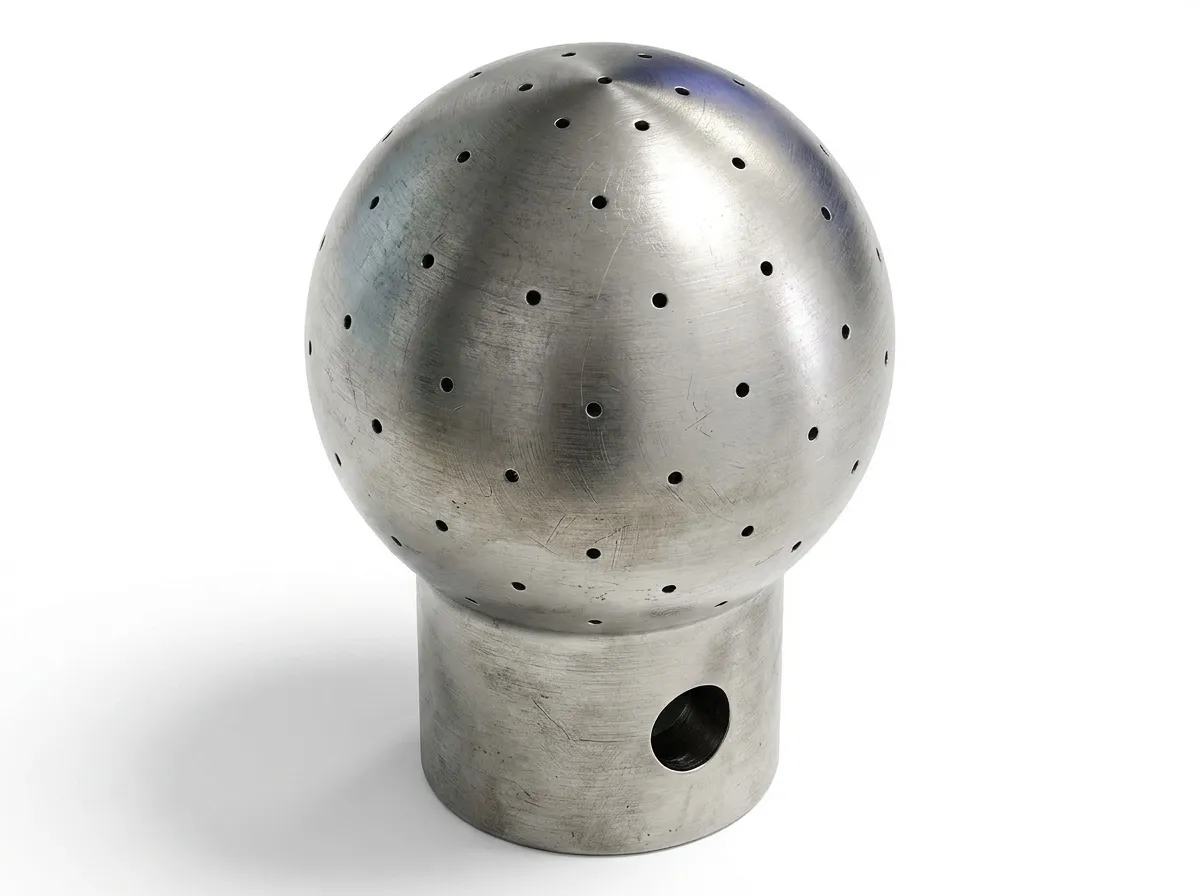
The component in question is a spherical spray head — sometimes called a shower filter ball, diffuser ball, or spray nozzle head — mounted on a short cylindrical shaft that presses or threads into a shower arm or handset body. It shows up in premium plumbing hardware, spa fixtures, and specialty misting equipment. Structurally, it breaks down into three machined features:
• A precision-turned cylindrical mounting shaft, sized to a tight press-fit or thread tolerance so it seats into the handset without play
• A cross-drilled retention or alignment hole through the shaft, used for a pin, set screw, or snap-fit during final assembly
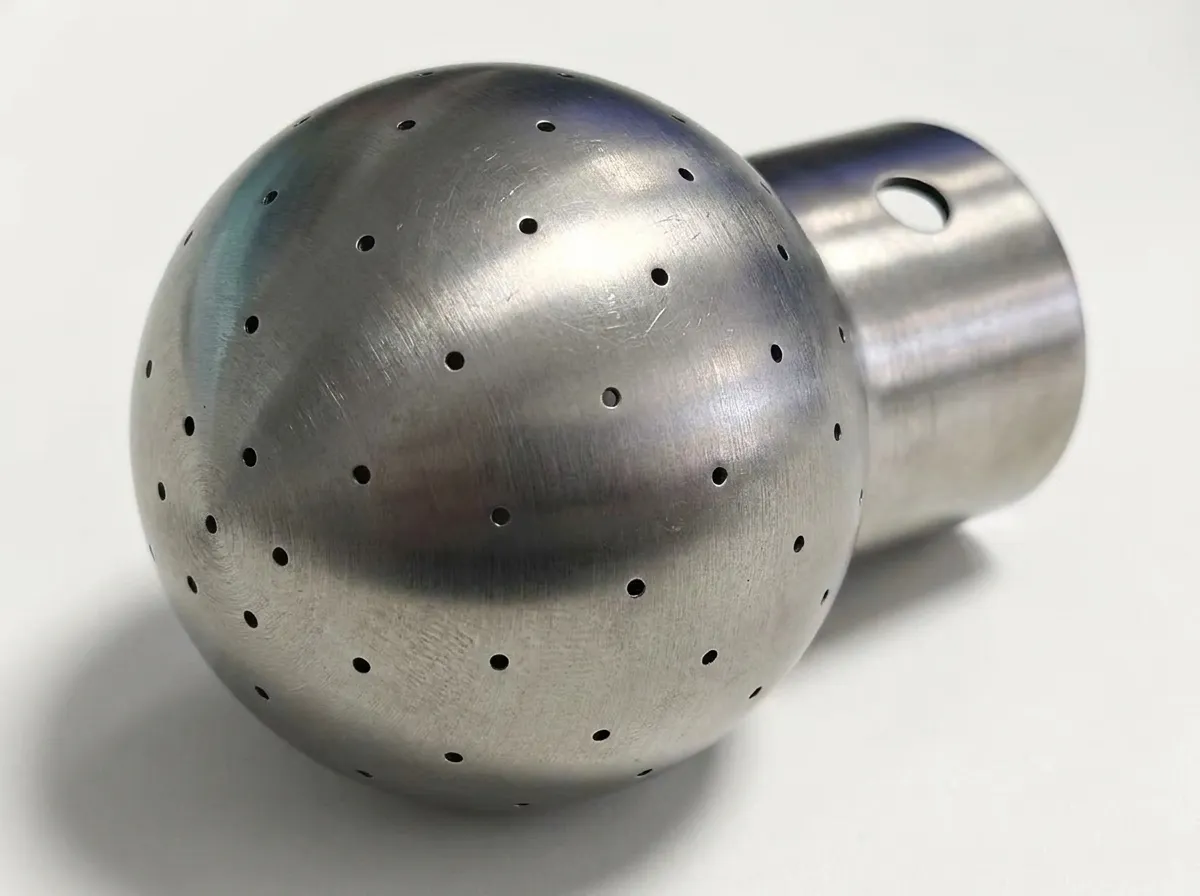
• A machined spherical head with dozens of small-diameter through-holes, arranged in a distributed pattern across the curved surface to control water flow, spray angle, and droplet size
None of those three features is difficult on its own. What makes the part demanding is that all three have to hold position relative to each other, and the hole pattern on the ball has to be consistent enough that the spray output doesn't have visibly "stronger" or "weaker" zones.
Why Titanium, Specifically
Aluminum and 304 stainless steel both show up in mid-tier shower hardware, but titanium — usually Grade 2 commercially pure or Grade 5 (Ti-6Al-4V) — is the material of choice once a brand is positioning a product as premium. A few reasons keep coming up in sourcing conversations:
• Corrosion resistance in constant water exposure — titanium forms a stable, self-healing oxide layer that resists pitting even under continuous mineral-rich or chlorinated water contact, a property well documented by materials researchers at ASM International, who note that unalloyed titanium withstands prolonged exposure to seawater, salt solutions, and chlorinated environments far better than most stainless grades.
• Weight — titanium runs roughly 45% lighter than stainless steel at equivalent strength, which matters for a part that hangs off a handheld shower head
• Hypoallergenic, nickel-free composition, which matters for skin-contact bathroom hardware sold into health-conscious retail markets
• A satin, slightly warm-toned finish after bead blasting that reads as "engineered" rather than "chrome-plated," which is increasingly what premium fixture brands are asking for
For traceability, most buyers ask for bar stock certified to ASTM B348/B348M, the governing specification for titanium and titanium alloy bars and billets — it's what lets a supplier document chemical composition and mechanical properties back to a mill certificate rather than a generic supplier claim.
The Real Engineering Challenge: Drilling a Sphere, Not a Flat Plate
Drilling a hole through flat stock is a solved problem. Drilling sixty-plus holes through a curved, three-dimensional surface — where every hole enters the material at a different compound angle relative to the spindle — is a different exercise entirely. A few things make this specific geometry unforgiving:
• Every hole location has to be programmed as a set of spherical coordinates, then translated into a toolpath that keeps the drill perpendicular (or at a deliberately controlled angle) to the local curvature at that point, not perpendicular to the machine's base plane
• Because titanium work-hardens quickly and has poor thermal conductivity, drill deflection or walking at the entry point is common if feed rate and spindle speed aren't matched to the alloy — on a curved surface, even a small deflection shows up as a visibly off-pattern hole
• Hole diameter and edge condition directly affect spray behavior, so burrs on the interior wall of the ball (which is hollow) have to be removed without hand-finishing sixty individual holes one at a time
• Fixturing the ball securely enough to resist drilling forces, without marking or crushing the finished spherical surface, usually requires a soft-jaw or custom collet built specifically for that part number
This is why the part is normally programmed and cut on a multi-axis CNC machining center with simultaneous rotary indexing (a 4th or 5th axis), rather than attempted on a 3-axis mill with manual repositioning. The CAM software maps the hole pattern onto the sphere's surface model, then generates a toolpath that re-orients the part (or the head) for every hole so the drill always meets the surface at the intended angle.
From Round Bar to Finished Filter: The Process
1. CNC turning: the shaft, sphere blank, and shoulder are turned from solid Ti-6Al-4V bar stock on a CNC lathe, holding the outside diameters and shoulder that later locate the part in the drilling fixture
2. Cross-drilling the shaft: the retention/alignment hole through the mounting shaft is drilled and, where needed, reamed to a slip- or press-fit tolerance for the assembly pin
3. Multi-axis hole drilling: the ball is indexed through its programmed hole pattern on a machining center with rotary axis control, cutting each of the spray holes to a consistent diameter and depth
4. Deburring and internal cleaning: interior burrs from drilling are removed — commonly by vibratory or media deburring rather than manual work, since manual deburring of dozens of internal holes is slow and inconsistent
5. Surface treatment: bead blasting or micro-abrasive finishing produces the satin appearance, and also helps knock down any remaining external burrs at the hole edges
6. Inspection: hole count, diameter, and position are checked (often with a CMM or vision system for a sample of each batch) before the part ships
Why Casting and Stamping Don't Work Here
It's worth being direct about why this part isn't cast, stamped, or MIM'd, since that question comes up in sourcing conversations:
• Casting titanium requires vacuum or inert-atmosphere melting because the metal reacts with oxygen and nitrogen at high temperature — it's done for some parts, but it adds cost and still leaves the small-diameter holes to be drilled afterward as a secondary operation, so it doesn't actually remove the hard part
• Stamping only works on sheet material being formed into simple shapes — a solid, hollow-drilled sphere isn't a stamping geometry at all
• MIM (metal injection molding) can produce complex shapes at high volume, but tolerance on hole position and diameter is harder to hold than with CNC, and tooling costs only make sense at very large production quantities
For low-to-mid production volumes, and for any run where hole-pattern accuracy affects a functional spray characteristic, CNC machining from bar stock remains the most predictable route to a repeatable part.
Where This Geometry Shows Up Beyond Shower Hardware
Once a shop can reliably drill a consistent hole pattern into a curved titanium or stainless surface, the same capability applies to a wider set of parts:
• Misting nozzle heads for outdoor patio cooling systems
• Aromatherapy and essential-oil diffuser heads
• Laboratory and pharmaceutical spray/shower fittings
• Industrial spray balls used for tank cleaning (CIP — clean-in-place — systems in food and beverage processing)
• Decorative perforated hardware for architectural and luxury retail fixtures
A Sourcing Checklist for Brands Specifying This Part
For procurement teams evaluating a CNC supplier for a titanium spray-ball or similar drilled-sphere component, it's worth confirming the following before committing to a production run:
• Material certification traceable to mill certificates (ASTM B348/B348M for bar stock, or the equivalent for the alloy specified)
• Whether the finished part needs to meet drinking-water contact requirements — in North America this typically means certification against NSF/ANSI/CAN 61, which sets health-effects requirements for materials that contact potable water
• Hole-pattern tolerance and how it's inspected — ask whether it's a sample-based CMM check or 100% vision inspection
• Surface finish options and whether bead blasting, anodizing, or PVD coating is available in-house or subcontracted
• Minimum order quantity and lead time for both prototype runs and production batches
Ready to Machine Your Next Precision Titanium Component?
MK Machinery works with plumbing, wellness, and industrial hardware brands to turn drawings like this one into production-ready parts. Our CNC machining capability covers multi-axis turning and milling for titanium, stainless steel, and aluminum, backed by in-house surface treatment including bead blasting, anodizing, and electroplating. We've applied the same precision-turning and tight-tolerance approach on projects such as our precision shaft component work and aerospace-grade titanium machining for international clients. If you're developing a spray ball, misting nozzle, or any complex drilled component, get a quote and our engineering team will review your drawing and recommend the most cost-effective process.