
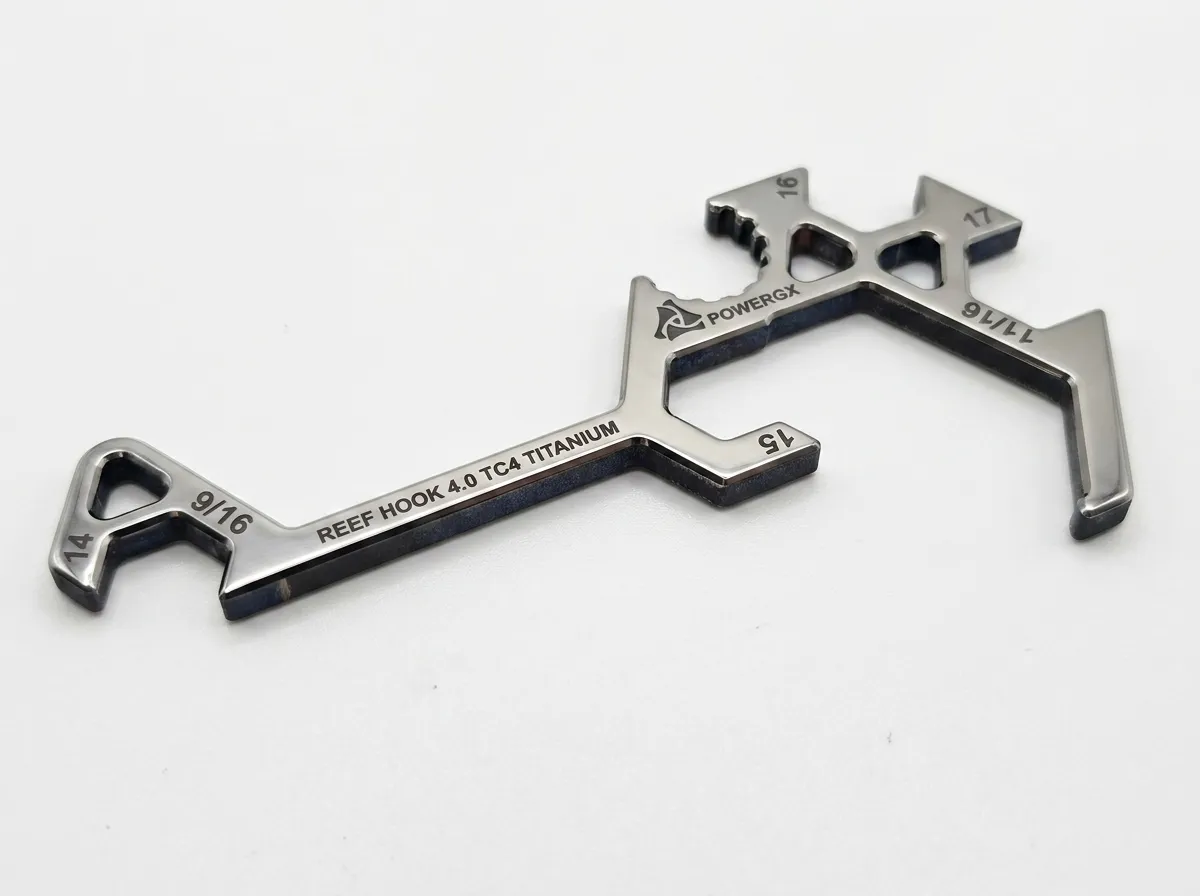
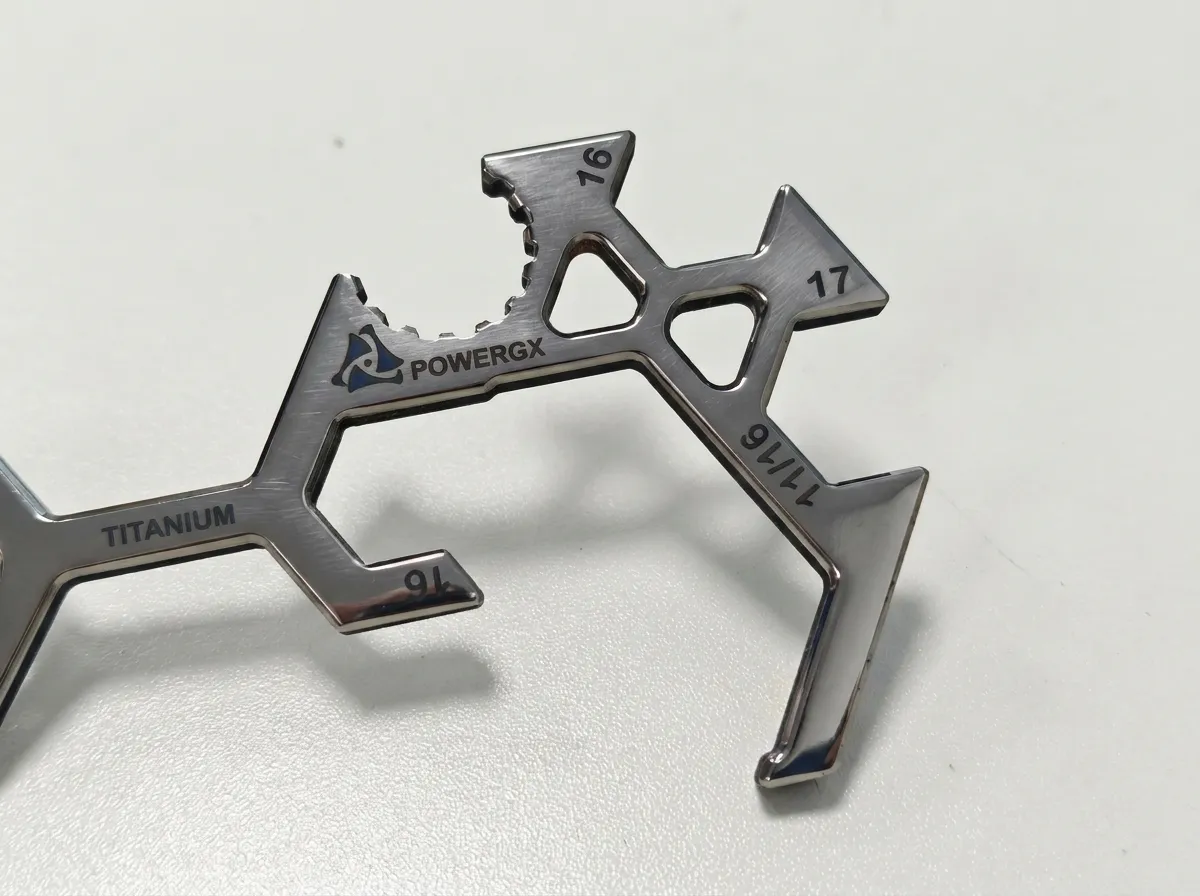
A titanium multi-wrench stamped REEF HOOK 4.0 lands on a machinist's bench, and the size markings tell most of the story before anyone opens a spec sheet: 14mm, 15mm, 16mm, 17mm, 9/16", 11/16" — six hex profiles branching off one another, plus a scalloped valve-key edge worked into the head. It's the kind of private-label tool that dive, marine, and outdoor-gear brands increasingly want built to their own drawing rather than pulled off a supplier's shelf. For a CNC shop, though, “just machine it in titanium” is never the whole brief. The material, the geometry, and the finish all pull in different directions, and getting a part like this off the machine looking as clean as it does takes more than loading an aluminum program with a different tool offset.
Why Titanium Ends Up in the Dive Bag
Divers already trust Ti-6Al-4V — the alloy stamped TC4 on Chinese mill certificates and better known elsewhere as Grade 5 titanium — for knives, line cutters, and reef hooks, and a multi-wrench like this one is built from the same material for the same reasons. It's an alpha-beta alloy, roughly 90% titanium with aluminum and vanadium making up the balance, and that combination is what gives it a strength-to-weight ratio that steel and most stainless grades can't match at a comparable thickness. A wrench body only 2-3mm thick can still take real torque without flexing or snapping.
Density is the other half of the appeal: TC4 sits at roughly 4.43 g/cm³, noticeably lighter than 316 stainless, which matters when a tool spends the dive clipped to a BCD rather than sitting in a toolbox. It's also non-magnetic — a detail that matters more underwater than it sounds, since it won't throw off a dive compass or a computer strapped nearby — and it shrugs off saltwater in a way that plain steel simply doesn't, so a tool like this doesn't come back from a season of diving pitted or streaked with rust.
The Machining Challenge Nobody Puts on the Drawing
Titanium is a difficult metal to cut, and the difficulty doesn't show up as a single dramatic failure — it shows up as heat that won't leave the cutting zone. Titanium's thermal conductivity is a fraction of aluminum's, so instead of dissipating into the chip and the coolant, heat concentrates right at the tool's edge. Push a feed rate that would be perfectly safe in aluminum and the same insert can round over or chip within minutes. Go too slow, or let the tool rub instead of shear, and the material work-hardens right where the next pass needs to cut clean, which is how chatter marks and dimensional drift creep into a part. Shops that machine titanium regularly lean on climb milling, coated carbide tooling, and carefully managed cutting parameters specifically to keep that heat and hardening under control.
A branched multi-wrench profile like this one makes the problem worse before it gets better. Between the 14mm jaw and the 9/16" hook, the webs of material are thin and the triangular cutouts leave long, unsupported spans — exactly the geometry that wants to deflect or vibrate under a cutting load. Left unmanaged, that shows up as wavy hex walls or a wrench opening that's a few hundredths of a millimeter off nominal, which is more than enough to make a tool bind on a fitting instead of seating flush.
Cost is the honest trade-off. Titanium bar stock runs several times the price of stainless per kilogram, and it eats tooling faster, so a titanium multi-wrench will never be the cheapest option on a supplier's quote sheet. For a tool that lives clipped to a diver's BCD for years, though, the math tends to work out — a titanium tool that never rusts and never needs replacing usually costs less over its service life than a stainless one that gets swapped out every couple of seasons.
Designing a Branched Multi-Tool So It Can Actually Be Machined
The six-in-one layout is what makes a tool like this appealing on a dive boat: one flat piece covers most of the hex fittings a diver will run into on a regulator, tank valve, or BCD hardware, instead of carrying six separate wrenches. But that same layout is a manufacturability problem before it's a convenience feature. Every branch that reaches out from the main body is a cantilever under cutting load, and every triangular cutout between branches removes material that would otherwise help the part resist vibration.
We push back on a few things at the design-review stage before a part like this ever gets programmed: sharp internal corners that concentrate stress and are hard to reach with a standard end mill, wall thicknesses that look fine on screen but won't survive a milling pass without chatter, and hex pockets spaced close enough together that finishing one wall disturbs the one next to it. None of that changes how the tool looks to the diver holding it, but it changes whether the batch comes off the machine consistent from the first part to the fiftieth.
From Drawing to a Six-Wrench Blank
Production starts with the flat multi-wrench profile — the branching outline, the six hex and open-end pockets, the scalloped valve key — programmed as a nested toolpath rather than machined feature by feature, so the thin webs stay supported by surrounding stock for as long as possible. We rough the profile first, let the part relax, then finish the hex walls and jaw faces in a lighter pass to pull deflection back out of the tolerance stack. Multi-tasking equipment like our Mazak INTEGREX platform, which combines turning and milling in one setup, keeps a part like this from being repositioned between operations, and every repositioning is another chance to lose a few thousandths.
It's a workflow that overlaps a fair amount with our broader CNC machining and precision fabrication services, just tuned for a difficult alloy and a part with no flat reference face to clamp against.
Holding Tolerance on a Part With No Straight Edges
A wrench only does its job if the hex opening matches the fastener, and on dive gear that fit matters more than usual — a wrench that rounds off a fitting underwater, or one that needs to be forced onto a valve nut, isn't just an inconvenience. We hold the same tolerance discipline on these hex profiles that we apply on far more visibly “critical” work, including aerospace components machined to ±0.005mm and AS9100-aligned inspection — the tolerance band is different for a hand tool, but the habit of checking every dimension against the drawing rather than trusting the program is the same.
On a multi-hex part specifically, that discipline shows up in a few concrete checks:
● Each hex opening gauged individually rather than assumed identical across the run
● Wall thickness verified at the thinnest webs, where deflection is most likely to show up
● First-article inspection before the full batch runs, so a drifting offset gets caught on part one, not part fifty
None of these checks are unique to titanium, but titanium is less forgiving of skipping them. A steel wrench that's slightly out of tolerance still mostly works; a titanium one machined with the wrong feeds and speeds can be dimensionally correct on paper and still have a work-hardened surface layer that chips a tool edge the very next time it's used.
The Finish Is Part of the Function
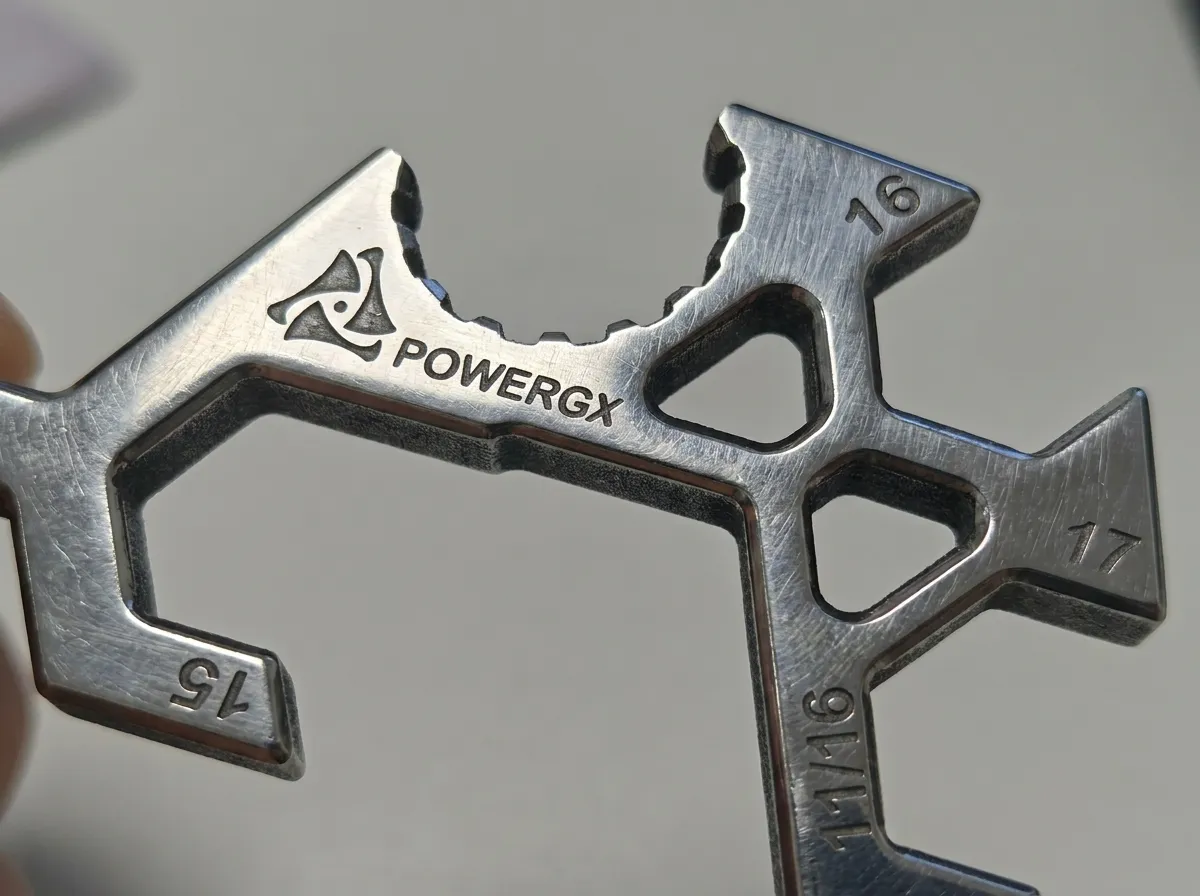
A mirror-polished titanium surface isn't just cosmetic on a part like this — it closes off the microscopic surface roughness where salt residue and moisture would otherwise sit, so the corrosion resistance the alloy is chosen for actually holds up over years of use. It's the same logic behind decorative work we've done for high-end brands that specify a mirror finish with strong corrosion resistance, just applied to a functional tool instead of a visible trim piece. Our surface treatment line handles the polishing pass after machining, and for parts that need a brand name or size markings to survive years of saltwater exposure, laser engraving holds up in a way that pad-printed ink simply doesn't.
Put together, the material choice, the machining strategy, and the finishing pass are really one decision made in three stages — each one has to protect what the previous stage got right, or the part that looks perfect on day one won't still look that way a season later.
Have a Custom Titanium Tool in Mind?
Whether it's a private-label dive tool, an EDC multi-wrench, or another small-batch titanium component that needs to hold tight tolerances and survive a harsh environment, MK Machinery can take it from drawing to finished, engraved part under one roof — 5-axis and multi-tasking CNC equipment, in-house surface treatment, and an ISO9001-certified process from first prototype through production runs. Get a quote and our engineering team will walk through material selection, tolerancing, and finishing options with you before a single chip gets cut.