
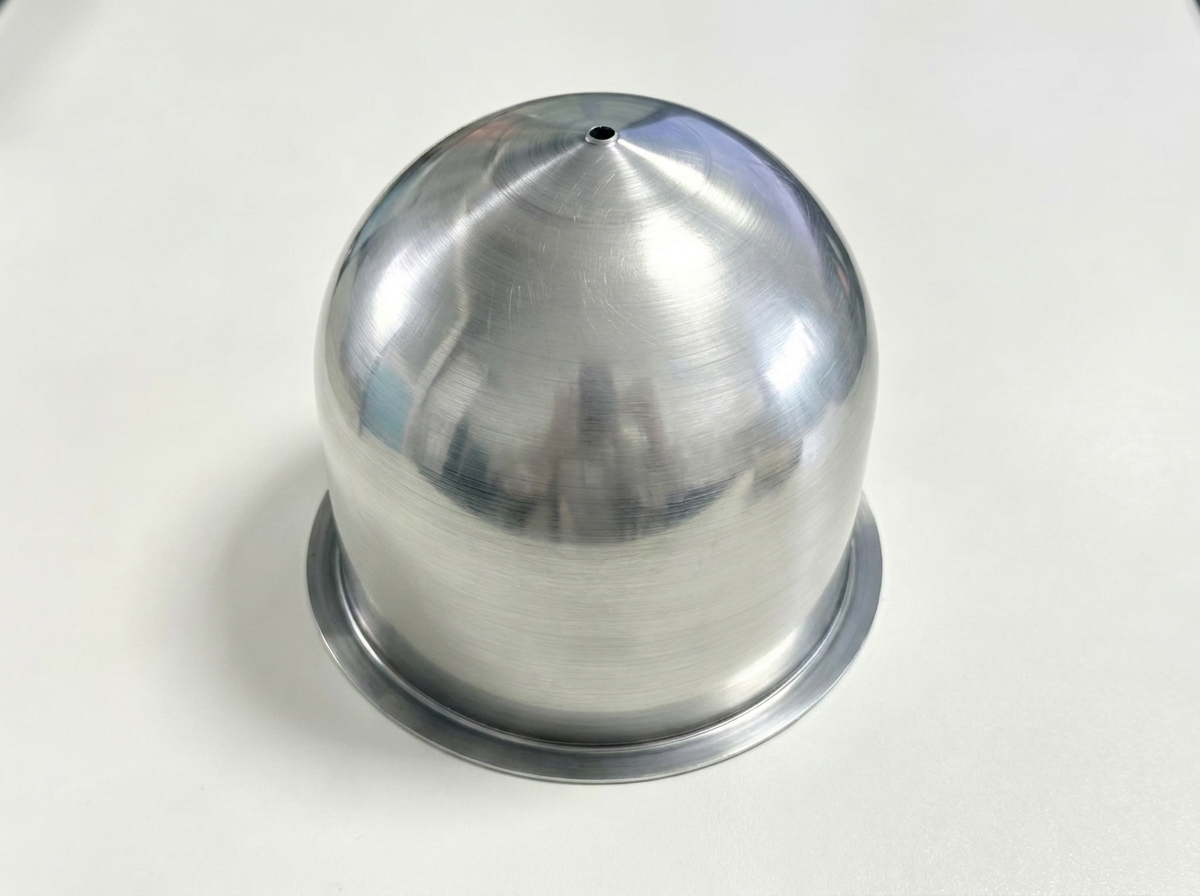
Walk past a Sic Bo table on any casino floor and you'll notice the dealer rarely touches the dice directly. Instead, a polished metal dome sitting inside a shaker base does the work — tumbling three dice through a fixed rotation cycle before locking the result in place for players to see. That dome isn't just a cover. Its curvature, wall thickness, bore alignment, and surface finish are engineering decisions that directly affect how fairly the dice roll and how many thousands of shake cycles the part survives before it needs replacing.
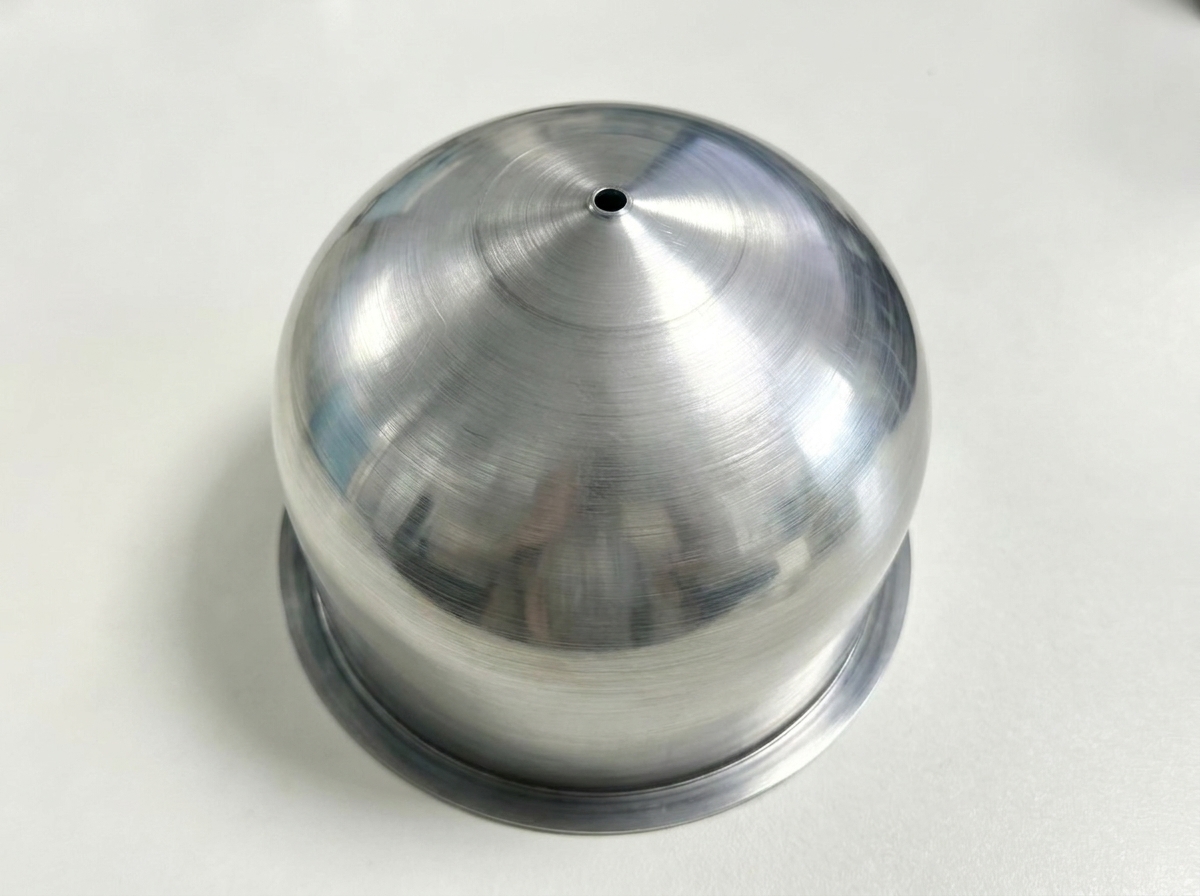
Top-down view of the machined aluminum shaker dome, showing the center spindle bore and mirror-polished contour.
At MK Machinery, gaming equipment brands occasionally come to us to source exactly this kind of component — a mirror-finished aluminum shaker dome like the one pictured here, machined from solid billet with a central spindle bore and a flanged base for mounting into an automated shaker housing. We put this guide together to walk through what actually goes into producing a part like this: the material choice, the CNC workflow, the tolerances that matter, and the finishing steps that separate a casino-grade component from a novelty one.
Why a Simple-Looking Dome Is a Demanding Part to Machine
A dice shaker dome looks like a straightforward hemisphere, but a handful of functional requirements make it more demanding than it appears:
● Even wall thickness. Any thick or thin spot shifts the part's mass distribution, which can bias how the dome swings during the shake cycle.
● True roundness. The dome has to be genuinely spherical, not just visually round, or the dice will tumble unevenly against the interior surface.
● Concentric center bore. Most automated shakers drive the dome from a motorized spindle through the small hole at the crown. If that bore isn't centered and true to the outer contour, the whole assembly wobbles.
● A flat, sealed flange. The base rim has to seat cleanly against the shaker tray — both to contain the dice and to prevent gaps that could be exploited for tampering.
● A snag-free interior finish. Rough tool marks inside the dome interfere with how freely the dice tumble and can chip the dice faces over time.
The table below summarizes how these requirements typically translate into machining specifications.
| Design Requirement | Why It Matters | Typical Target |
| Wall thickness consistency | Prevents mass imbalance during the shake cycle | Variance within ±0.10 mm |
| Sphericity / roundness | Keeps dice tumbling evenly against the dome interior | Within 0.05 mm of true form |
| Center bore concentricity | Keeps the motor-driven spindle running true | Runout ≤ 0.03 mm |
| Flange flatness | Ensures a clean, tamper-resistant seat against the tray | Flat within 0.05 mm |
| Interior surface finish | Lets dice tumble freely without snagging or chipping | Ra ≤ 0.4 µm (polished) |
Material Selection: Why Aluminum Wins Over Stainless or Acrylic
Three materials dominate this category of gaming hardware: aluminum alloy, stainless steel, and clear acrylic or glass, which is used mainly for viewing domes rather than shaker bodies. Each comes with tradeoffs.
Aluminum alloys such as 6061 and 5052 are the most common choice for shaker domes because they cut cleanly on CNC equipment, hold a fine surface finish after polishing, and weigh roughly a third of stainless steel for the same volume — an advantage when the part has to be flung through a repeated shake cycle without straining the drive motor. 6061 in particular is valued for a stable, self-forming oxide layer that gives it solid resistance to everyday corrosion, and it responds well to anodizing for casinos that want a specific color finish or extra surface hardness.
| Material | Machinability | Relative Weight | Corrosion Resistance | Best Fit |
| Aluminum 6061 / 5052 | Excellent — clean cuts, fine finish | Light (~2.7 g/cm³) | Good, improves with anodizing | Shaker domes, housings |
| Stainless steel 304 | Moderate — slower cuts, more tool wear | Heavy (~7.9 g/cm³) | Excellent, no coating needed | Bases, structural brackets |
| Acrylic / polycarbonate | Good for simple shapes, prone to stress marks | Very light (~1.2 g/cm³) | Not applicable (non-metal) | Viewing windows, display domes |
From Billet to Bowl: The CNC Machining Workflow
Producing a dome like the one shown starts with a solid round aluminum billet, not a casting or a spun sheet blank — this is what gives the part its uniform density and lets it hold a true sphere under machining. A typical production sequence looks like this:
● 1. Billet facing and rough turning. The raw stock is faced and rough-turned on a CNC lathe to establish the outer hemisphere and rim profile, leaving stock for finishing passes.
● 2. Contour finishing. A finishing pass follows the spherical contour precisely, bringing the part to its final outer diameter and wall profile.
● 3. Center bore drilling. The spindle-engagement hole at the crown is drilled and reamed on a precision setup so it stays concentric with the outer sphere.
● 4. Flange machining. The base rim is faced flat and sized so it seats correctly against the shaker's tray or housing.
● 5. Deburring and edge break. All machined edges are deburred by hand or on a rotary finishing setup to remove sharp edges before polishing.
● 6. Mechanical polishing. The dome is buffed through a series of abrasive stages to reach a mirror finish, both for appearance and to eliminate tool marks that would otherwise catch on the dice.
● 7. Inspection. Roundness, wall thickness, bore concentricity, and flange flatness are checked against drawing tolerances before the part ships.
Each of these stages is a place where a rushed process shows up later as a wobbling shaker or a scuffed dome, which is why tolerance control at every step matters more than it would on a purely cosmetic part.
The Tolerances That Actually Protect Game Integrity
For gaming equipment, tight tolerances aren't just a quality nicety — they're what keeps the dealer, the pit, and the player looking at the same fair outcome. The table below outlines the tolerance ranges we typically work to on components like this.
| Process Stage | Typical Equipment | Achievable Tolerance |
| Rough turning | CNC lathe | ± 0.05 mm |
| Contour finish turning | CNC lathe with live tooling | ± 0.02 mm |
| Center bore drilling/reaming | Precision drilling setup | Concentricity ≤ 0.01 mm |
| Mirror polishing | Multi-stage mechanical buffing | Ra 0.2–0.4 µm |
| Final inspection | CMM and roundness tester | Full dimensional report per batch |
For equipment destined for regulated markets, this level of dimensional control also supports the compliance process. Manufacturers selling into jurisdictions like Nevada work within a framework of technical standards maintained by the Nevada Gaming Control Board, and consistent, well-documented component tolerances make it easier for OEMs to demonstrate that a device performs the same way, unit after unit.
Surface Finishing: More Than Just Shine
The mirror finish on a shaker dome isn't purely cosmetic. A polished aluminum surface resists fingerprint etching and everyday wear better than a matte one, and — as materials suppliers such as Xometry note in their overview of 6061 aluminum — a smooth, well-finished surface helps preserve the alloy's natural corrosion resistance by keeping the protective oxide layer intact. For casinos that want a house color or extra scratch resistance, anodizing is a common next step after polishing; it's a process we handle in-house alongside CNC machining, so the part doesn't have to travel between vendors.
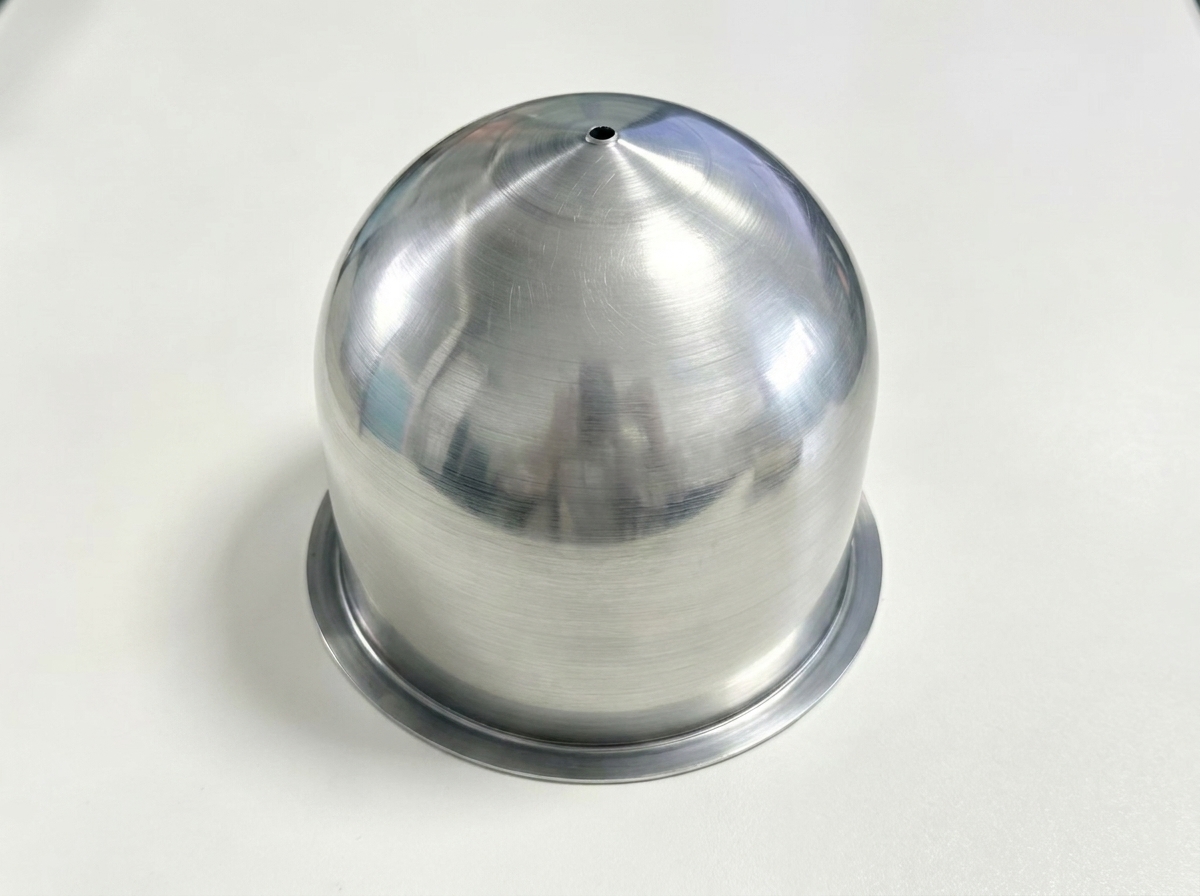
Side profile of the finished dome, showing the flanged base that seats into the shaker housing.
A Fast-Moving Category of Equipment
Dice shaker hardware has been evolving quickly on the design side, too. Some of the larger gaming equipment manufacturers have redesigned their automated shaker domes in recent years specifically to reduce weight and noise while improving how consistently the dice settle — TCSJOHNHUXLEY's D-i-Shaker is one public example of a manufacturer reworking its dome geometry and shake cycle for exactly these reasons. It's a reminder that even a component that looks unchanged from the outside is often being refined at the machining and materials level.
Case in Point: A Recent Aluminum Shaker Dome Project
The dome pictured in this article is representative of a project we recently completed — a solid aluminum shaker cover with a polished mirror interior and exterior, a precisely centered spindle bore, and a wide, flat-seated flange for mounting into an existing shaker housing. The brief called for a part that would hold its shape and finish through continuous daily use on a casino floor, a different bar than a display or promotional piece needs to clear. It's a good example of the small-batch, tight-tolerance aluminum work we produce regularly — in the same spirit as our CNC aluminum guitar tuner project, and comparable in finish quality to the decorative surface treatment work we've completed for other clients.
Why Manufacturers Choose MK Machinery for Gaming Equipment Components
● Full-service capability. CNC turning and milling, polishing, and anodizing or plating all happen under one roof, which shortens lead times and keeps tolerances consistent across processes.
● Small-batch and production runs. Whether a client needs a handful of prototype domes or an ongoing production order, our equipment and workflow scale to both.
● Material expertise. Our team works daily with 6061, 5052, and stainless alloys, and can recommend the right grade based on weight, finish, and durability requirements.
● Quality documentation. Roundness, concentricity, and surface finish reports are available on request, which matters for OEMs managing their own regulatory submissions.
● 20 years of precision machining experience, backed by ISO9001-certified quality processes and 5-axis equipment for complex geometries.
Ready to Source Your Next Precision Aluminum Component?
Whether you're developing gaming equipment, consumer hardware, or an industrial part that demands tight tolerances and a flawless finish, MK Machinery brings CNC machining, surface treatment, and quality inspection together in one facility. We've helped clients bring everything from titanium dive tools to aluminum instrument hardware from concept to finished production part. Send us your drawings or a reference sample — like the shaker dome in this article — and our engineering team will get back to you with a manufacturing plan and quote within one business day. Get a quote or explore our full range of CNC machining services to see how we can support your next project.